
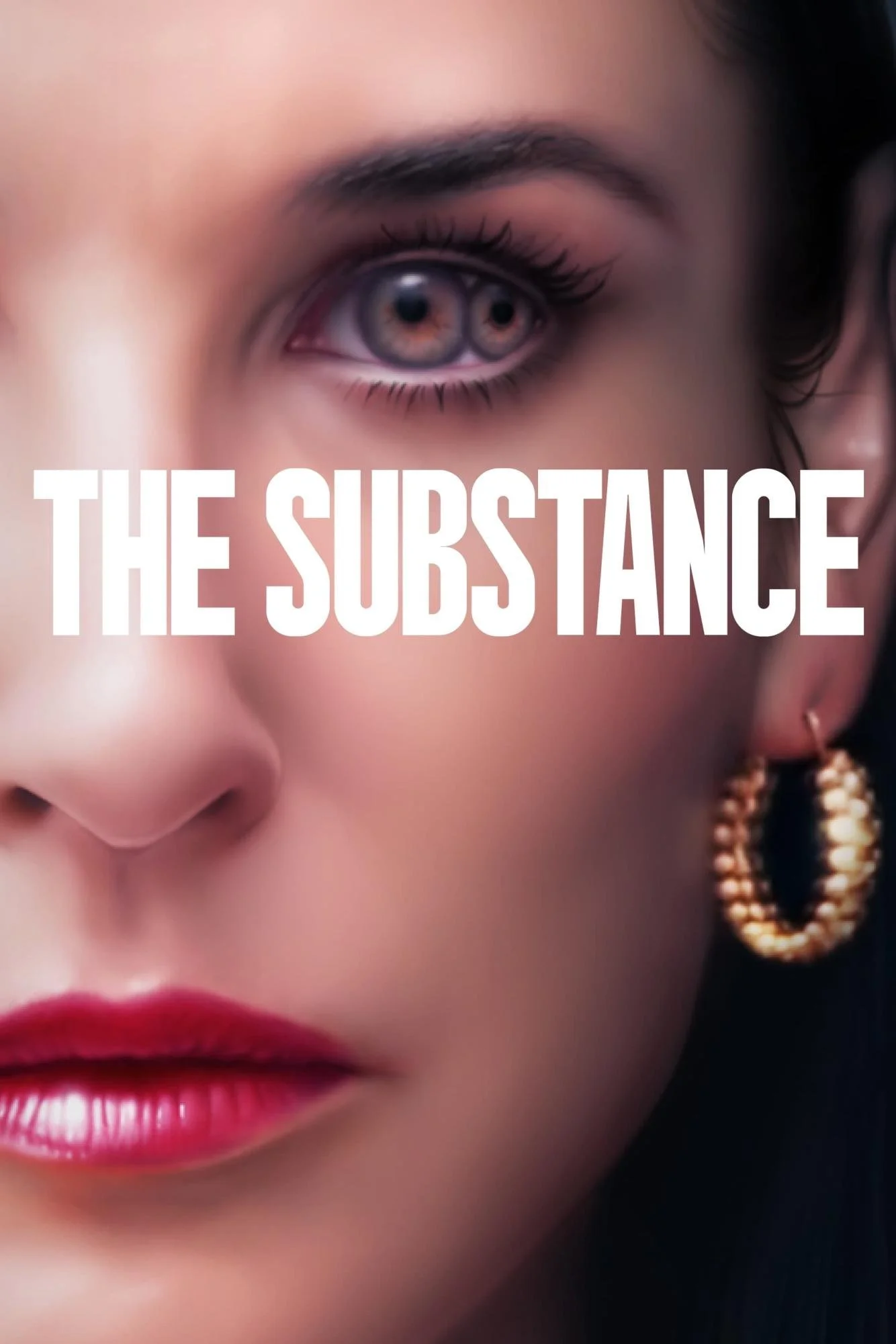
It’s been a year since I was first blown away by The Substance and I’ve been meaning to write a review of it.
Spoilers ahead!
The 2025 body horror film directed by Coralie Fargeat, starring Demi Moore and Margaret Qualley explores the complexities of beauty standards, ageism and the lengths we will go to for beauty. In the film, Demi Moore’s character, Elisabeth, distraught and discarded by the entertainment industry, acquires a black-market drug known as The Substance. The product allows her to birth a younger, more "perfect" version of herself named Sue.
Conditioning to be a ‘good girl’
Although Elisabeth is initially presented as a woman with confidence and self-acceptance, we catch glimpses of the ways she has internalised the words and expectations of others. Dennis Quaid's character, Harvey, is her producer and represents an industry that constantly degrades her and chips away at her self-worth.
Elisabeth finds herself completely at the mercy of other people's expectations, feeling she has no choice but to take the substance. We see the stark contrast between the way Harvey treats Sue and Elisabeth, despite them being the same person underneath.
We see the extent of this conditioning in the scene where Elisabeth is curled up in the shower, banging her head against the floor and repeating, ‘Stop it.’ We see her fighting against both the self-imposed cage in her mind and the cage that society has trapped her in. Even when Sue is experiencing complete mental, physical and emotional turmoil, Harvey tells her to smile, saying, ‘Pretty girls should always smile.’ And she complies, still believing that obedience will bring her the love and acceptance she craves.
These themes cross over into the world of birth, where many people find themselves trying to break deeply ingrained patterns and societal expectations. This is especially true for women and people of marginalised genders, who may have been conditioned to behave in a ‘polite’ or agreeable way, even when alarm bells are ringing.
As a doula, I see this when people share that something didn't feel right, but they went along with it because they didn't want to make a fuss. This might be agreeing to a membrane sweep they weren't comfortable with, accepting an induction without feeling fully informed, or finding themselves caught in a cascade of medical interventions they hadn't anticipated.
There are so many layers and complexities behind the decisions we make. In birth especially, it is incredibly important to be able to shut out the noise, listen to your instincts and make decisions that feel right for you and your baby. At a time when so many new expectations are placed on you as a parent, it can be easy to fall back into familiar patterns of obedience and people-pleasing, even when they no longer serve you.
The value placed on one version of beauty
I also loved the use of breast imagery throughout the film. The comparison between Elisabeth's breasts and Sue's, and then finally Monstro Elisasue's, where she births an entire breast from her face, was incredible. To me, this moment resembled a baby's head crowning during a vaginal birth.
The audience's disgust at this scene was so powerful. It highlighted the way breasts are only ‘allowed’ to exist in certain contexts, usually when sexualised, rather than as functional parts of our bodies that can feed and nourish another human being. It also made me think about the discomfort and disgust that society can have towards birth itself, particularly when birth is witnessed in a way that feels unfamiliar, messy or outside of what we have been conditioned to see as acceptable.
There is such a stark contrast between the celebration of breasts as objects of sexual desire and the discomfort surrounding their other functions. The film takes this to the extreme, forcing the audience to confront their own reactions to bodies that don't fit neatly into society's expectations of beauty.
Self-acceptance
The scene where Elisabeth violently removes her makeup shows the violence we can enact upon ourselves. It doesn't matter how beautiful her outfit or makeup is; the way she feels on the inside, and her overwhelming lack of self-acceptance, makes it impossible for her to see herself as beautiful.
Although there is little dialogue in the film, the visual storytelling reveals so much about how Elisabeth and Sue feel towards the different versions of themselves. In the first week after Sue is created, she takes the time to carefully stitch Elisabeth back up and place a towel beneath her head. But as the film progresses, Sue becomes increasingly disgusted by Elisabeth's loneliness and ageing body, believing herself to be more deserving of life, love and companionship. Elisabeth initially admires Sue and her beauty, but gradually begins to resent her for everything she has taken. Sue has stolen her job, her identity and, quite literally, her body, by taking more than her allotted share of the stabilising fluid.
When Elisabeth wakes up before the New Year's Eve party, completely disfigured, she finally recognises the harm Sue has caused and decides to terminate the process. We see her shouting at her inner critic, telling it to ‘shut the fuck up’. But as she begins injecting Sue with the termination fluid, she stops, saying, ‘You're the only lovable part of me.’ It's such a devastating moment. Elisabeth is finally admitting that the only part of herself she has ever truly valued is her beauty, and without it, she believes she has nothing.
In a film filled with so much self-hatred, it was a joy to see the final moments where Elisabeth seems to find a sense of self-acceptance. As Monstro Elisasue falls apart, revealing a pile of sludge topped by Elisabeth's face, we finally see her smiling. She is no longer caged in by the physical form that has been scrutinised and criticised by herself and others throughout her life. There is something strangely peaceful about this moment, as though she can finally let go.
Although the film makes it clear that Sue and Elisabeth are one, they follow different trajectories throughout the story. We also see Sue gain a level of self-acceptance when she transforms into Monstro Elisasue. In her monstrous form, she adorns herself with earrings and places a cut-out of Elisabeth's face over her own, perhaps finally recognising and accepting the beauty she had at the beginning of the film.
I see so many interesting parallels here with body image during pregnancy and the postnatal period. Women's bodies are already heavily scrutinised, and that scrutiny seeps into pregnancy, birth and the postnatal period. There is so much pressure to look a certain way, to embrace the changes of pregnancy but still fit into an accepted norm. The postnatal body, especially, is so often hidden away. Sagging skin, stretch marks, enlarged areolas, hyperpigmentation, sore and cracked nipples. These are all normal experiences of bodies that have undergone enormous changes, yet they are rarely represented in the images of motherhood we're encouraged to celebrate.
The scene where Monstro Elisasue sprays the audience with blood feels like a final ‘fuck you’ to society's unrealistic and harmful portrayals of beauty. A refusal to hide away the parts of ourselves that others might find uncomfortable, messy or unappealing.
But our bodies aren't the only parts of ourselves we may struggle to accept. I think that's why this film resonates with so many people. We all have an inner critic whose voice can become quieter or louder depending on the circumstances and phases of our lives. During pregnancy, birth and the postnatal period, there are so many moments when we might find ourselves thinking: I'm not doing this right. I should be better. I'm not enough. Shame and self-doubt can show up in so many different ways, particularly during a time when our identities, bodies and relationships are shifting. I explore this further in another blog, Unveiling Shame in Birth: Where It Comes From and How We Begin to Heal.
The importance of community
Elisabeth doesn't appear to have friends or family to connect with. The only validation she receives comes from an industry that has decided she has reached her expiration date. I think this is such an important nuance in the film. If Elisabeth had someone in her life who could affirm and validate her worth as a human being, beyond her beauty, perhaps she might have been able to believe it herself.
This really struck me as a doula. I see firsthand the difference that community makes, especially during the transition into parenthood. At a time when so much of our identity is changing, having people around us who can remind us of our worth, beyond how we feel about our bodies, what we achieve or what we do for others, is incredibly powerful.
We need affirmation, love and care. We need people who see us as whole human beings, who can hold space for us when things feel overwhelming and remind us of who we are when we begin to lose sight of ourselves. And perhaps most importantly, we need to know that we are worthy of love and belonging without having to earn it.
Connections to midwifery
The film also made me think about the broader impacts of misogyny, not just in pregnancy and birth, but in the history of midwifery itself.
As Sue continues stealing from Elisabeth, Elisabeth's body begins to transform. Her skin wrinkles, her joints become stiff and creaky, and her hair turns grey. The scene where she is cooking enormous, repulsive dishes particularly stood out to me. It resembles the familiar portrayals of witches stirring potions over cauldrons, casting spells and creating something sinister. It made me think about the history of midwifery and the ways that women with knowledge of birth, healing and their own bodies have historically been viewed with suspicion, sometimes accused of witchcraft or portrayed as dangerous and untrustworthy.
Rather than seeing an ageing woman as someone who may hold years of knowledge, experience and ancestral wisdom, we've been conditioned to look away, dismiss her or even fear her. There is something deeply unsettling about the way ageing women are portrayed as monstrous, while youth and beauty are celebrated as the ultimate symbols of worth.
And I think this connects so powerfully to the way women's knowledge, particularly knowledge surrounding our bodies, reproduction and birth, has so often been dismissed or devalued.
The Substance takes these ideas to grotesque extremes, but beneath all the blood and body horror are questions that feel incredibly familiar: Who gets to decide what makes us valuable? What happens when we internalise those expectations? And what might it look like to finally accept ourselves, in all our changing, imperfect and wonderfully human forms?